Learn how to crack your first tech interview with coding practice, technical interview questions, mock interviews, aptitude preparation, and resume tips for BTech freshers.
# How to Crack Your First Tech Interview: A Guide for BTech Freshers
Nobody expects a fresher to know everything. What interviewers want to see is whether you understand the fundamentals, can work through a problem you haven't seen before, and can explain your thinking along the way.
That is good news, because all three can be practised. Here are six steps to prepare for your first technical interview, including what to do in the room when a question stumps you.
1. Master the Basics Before Advanced Topics
Most entry-level technical interviews stay close to the fundamentals. Strong basics beat a shallow tour of advanced topics every time.
Pick one language and know it well.
C++, Java or Python all work. Be comfortable with loops, functions, arrays, strings, pointers or references, and how your language handles memory and errors.
Then revise the core subjects.
Object-Oriented Programming (OOP)
Prepare concepts such as:
- Polymorphism.
- Method overloading vs method overriding.
- Abstract classes vs interfaces.
- Inheritance, encapsulation and abstraction.
Be ready to explain each concept with a practical example.
DBMS and SQL
Revise database fundamentals and practise common queries.
- What is database normalisation?
- What are the different types of SQL joins?
- How do primary keys and foreign keys work?
- How would you write a query to find the second-highest salary?
Operating Systems
Focus on frequently discussed concepts:
- Process vs thread.
- Deadlocks and their causes.
- Virtual memory.
- CPU scheduling and memory management.
Computer Networks
Understand the fundamentals of networking:
- TCP vs UDP.
- OSI and TCP/IP models.
- HTTP vs HTTPS.
- DNS and what happens when you type a URL into a browser.
Aim to understand, not memorise. Interviewers often follow up with "Why?" or "Give me an example", and a memorised definition falls apart at that point.
Regular DBMS and SQL technical MCQ practice is a quick way to find gaps before the interviewer does.
2. Practise Coding Every Day, with a Method
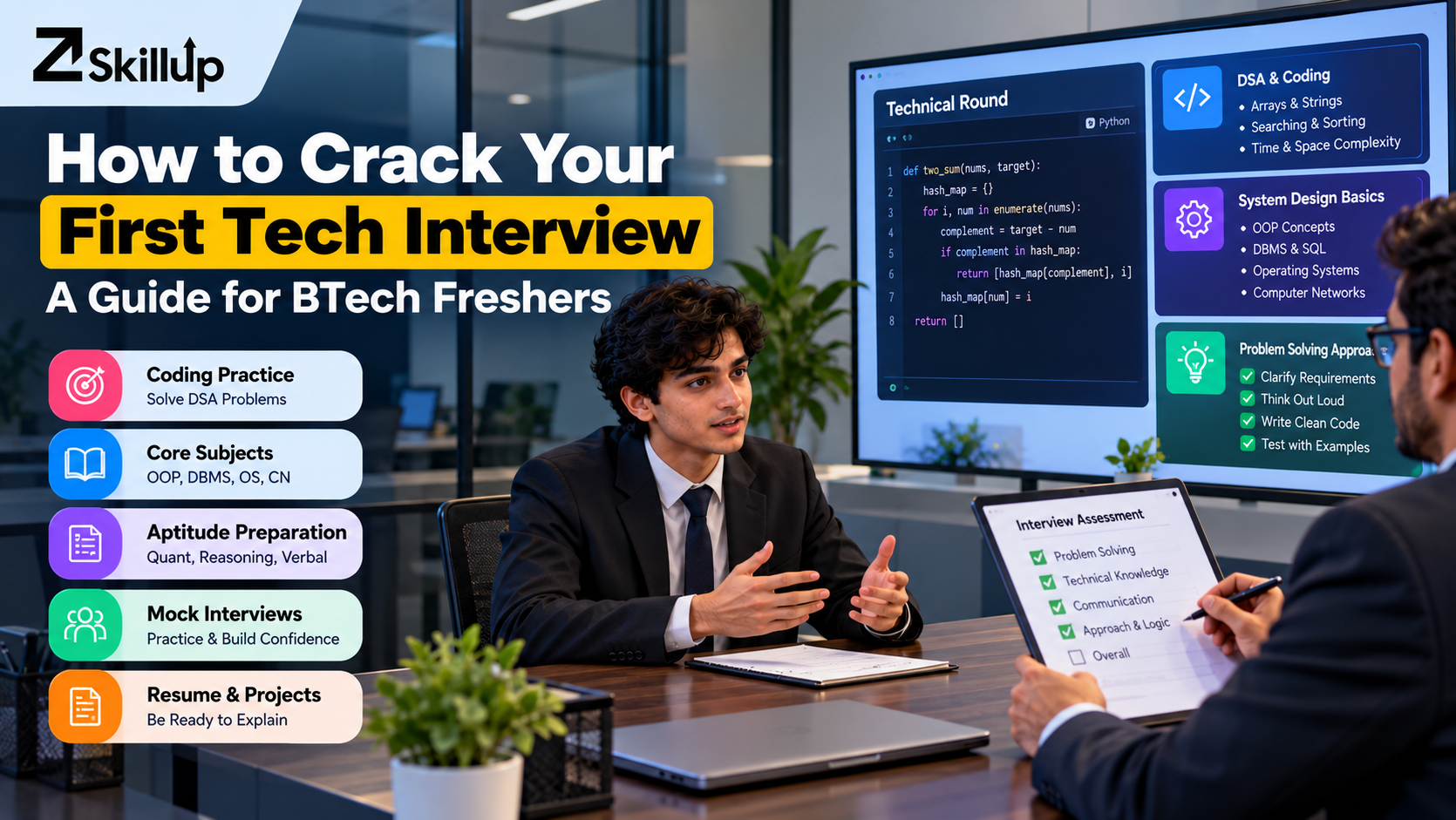
Coding rounds test how you approach a problem as much as whether you solve it. Two or three DSA coding practice questions a day, done properly, are worth more than ten rushed ones.
Start with arrays, strings, sorting, searching, hash maps and basic recursion. Once those feel comfortable, move on to linked lists, stacks, queues and simple trees.
For every problem, practise the same five steps you'll use in the interview.
Step 1: Restate the problem.
Explain the problem in your own words and confirm the expected input and output.
Step 2: Explain a simple approach first.
Start with a straightforward solution, even if it is not the most efficient one.
Step 3: Improve your approach.
Consider whether you can reduce time or space complexity, and explain why your improved approach is better.
Step 4: Write clean code.
Use clear variable names, follow your language's conventions and structure your solution logically.
Step 5: Test and analyse it.
Walk through a normal example and edge cases, including empty input, a single element and duplicates. Then state the time and space complexity.
Doing this every day makes it automatic, which matters when interview nerves kick in.
3. Prepare Your Resume and Projects as Interview Material
Your resume is the interviewer's question list. Anything on it is fair game, so treat every line as something you'll be asked about.
Include two or three projects that show real technical work. For each project, prepare answers to these questions:
- What problem does it solve, and why did you build it?
- What was your specific contribution, if it was a team project?
- Why did you choose this technology stack?
- What was the hardest bug or challenge, and how did you fix it?
- What would you improve with more time?
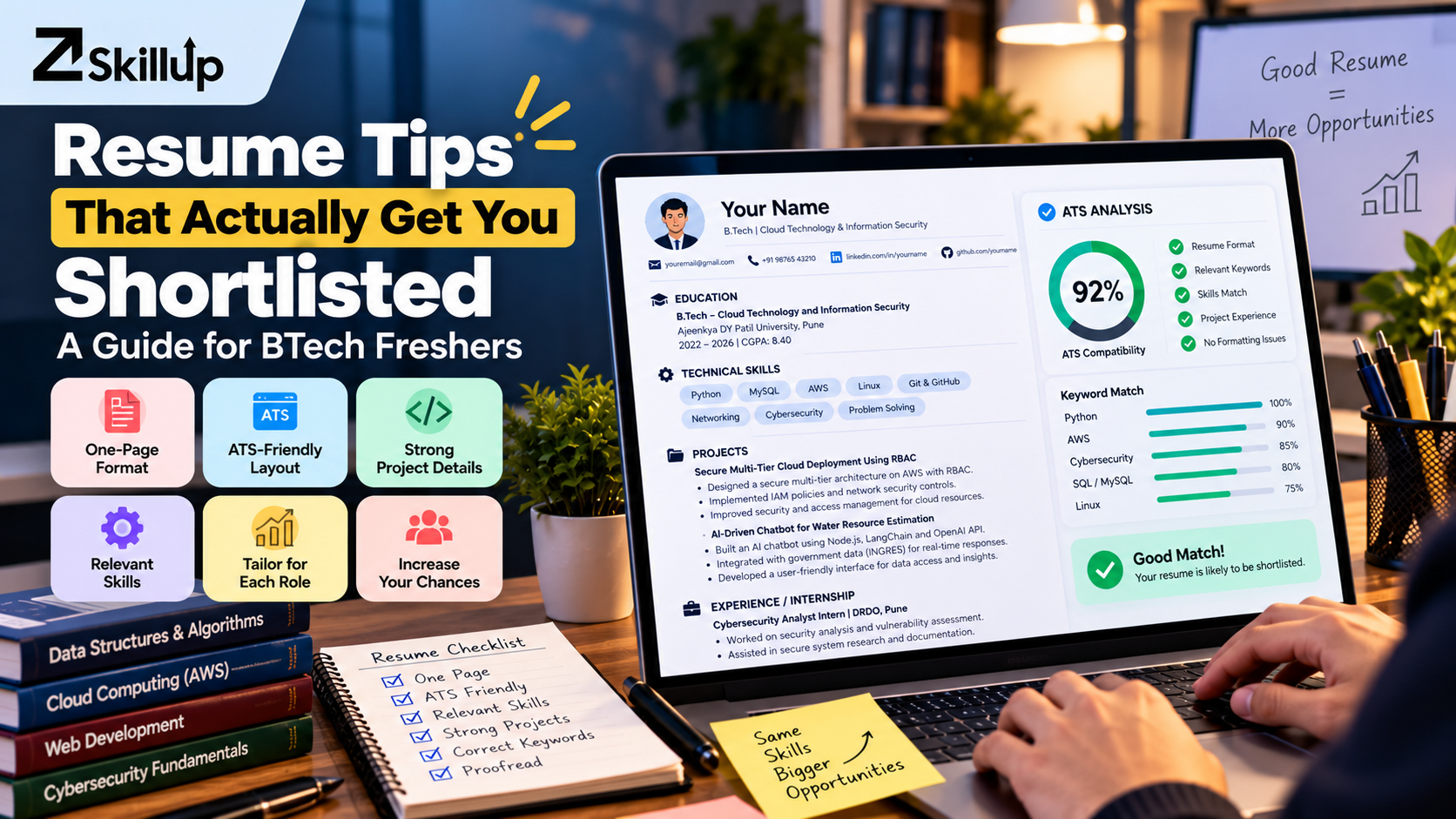
Keep the resume itself simple and ATS-friendly: one page, standard headings, relevant technical skills, and short project bullets that show what you built and the result.
An ATS-friendly resume builder for freshers can help with formatting. Most importantly, include only skills you can explain confidently.
If you have internship experience, be prepared to discuss your responsibilities, technical contributions and the results of your work.
4. Rehearse with Mock Interviews
Knowing an answer and saying it clearly under pressure are different skills. The second one only improves with practice out loud.
- Complete three to five mock interviews: Practise technical, project-related and HR questions before your first real interview.
- Use different formats: Practise with a friend or senior, and use an AI mock interview tool for additional rounds and feedback.
- Record yourself once: Watching the recording can reveal filler words, rushed explanations and answers that ramble.
- Time your answers: Aim for one to two minutes per answer. Your introduction should take about 60 seconds.
After each mock interview, note the questions you struggled with and revise those topics before the next round.
Common technical interview questions for freshers, particularly about your main programming language, SQL, OOP and projects, should become easier with consistent practice.
5. In the Room: What to Do When You're Stuck
Every candidate encounters a question they can't answer immediately. How you handle that moment often matters more than the answer itself.
Ask a clarifying question.
For example: "Can the input contain negative numbers?"
Clarifying the requirements shows that you think carefully before jumping into a solution.
Think out loud.
Share what you're considering, even if your reasoning is incomplete. Interviewers can follow your thought process and may offer hints.
Start simple.
A working brute-force solution is better than a half-finished clever one. Once it works, explain how you would improve it.
Be honest about gaps.
If you don't know a concept, say so, then share what you do know that's related. Bluffing is easy to spot and hard to recover from.
Stay calm after a mistake.
Correct your mistake, move on and don't let one question affect the rest of the interview.
Cracking a technical interview does not mean having every answer. It means showing clear, honest problem-solving and a willingness to work through challenges.
6. Don't Skip the Rounds Before the Interview
At many companies, especially service-based IT firms, you only reach the technical interview after clearing an online assessment. Good campus placement preparation covers both.
Quantitative Aptitude
Practise percentages, ratios, averages, probability, permutations and other common quantitative topics. Solve questions under a timer to improve speed and accuracy.
Logical Reasoning and Verbal Ability
Work on logical reasoning, data interpretation, reading comprehension and verbal ability. Focus on understanding question patterns and managing your time.
Placement Mock Tests
Take an online placement mock test early to establish your baseline. Then use company-specific placement papers and timed tests to work on your weak areas.
Company-Specific Preparation
If TCS is on your list, for example, TCS NQT preparation covers aptitude, reasoning, verbal ability and coding in one format.
Review the recruitment pattern for each company you apply to, as assessment formats and selection criteria can vary.
If you've completed an internship, be ready to explain your contributions and results in detail. Interviewers often treat internship experience as one of your strongest examples of practical work.
Start Preparing with Prephasz
Cracking your first tech interview comes down to strong fundamentals, daily practice and clear communication. Start early, practise consistently, and rehearse until explaining your thinking feels natural.
Prephasz helps BTech students prepare for service-based IT company placements with company-specific learning materials, tests, mock interviews and a resume builder.
Use these resources to strengthen your fundamentals, identify weak areas and build confidence before your next interview.
Start practising with Prephasz today and walk into your first tech interview ready.
Put this into practice
Drill these exact patterns with adaptive practice, timed mocks and company-wise assessments on prephasz.
Start practising free