Discover practical resume tips for BTech freshers, including one-page formatting, ATS-friendly layouts, project descriptions, and ways to improve your chances of getting shortlisted.
Resume Tips That Actually Get You Shortlisted: A Guide for BTech Freshers
A recruiter often spends only a few seconds on a resume before deciding whether to read on. In that time, they are looking for three things: what you can do, what you have built, and whether it fits the role.
For BTech freshers applying to IT and software jobs, that means a resume that is short, specific and easy to scan, not long or visually elaborate. Here are practical tips to help yours make the shortlist.
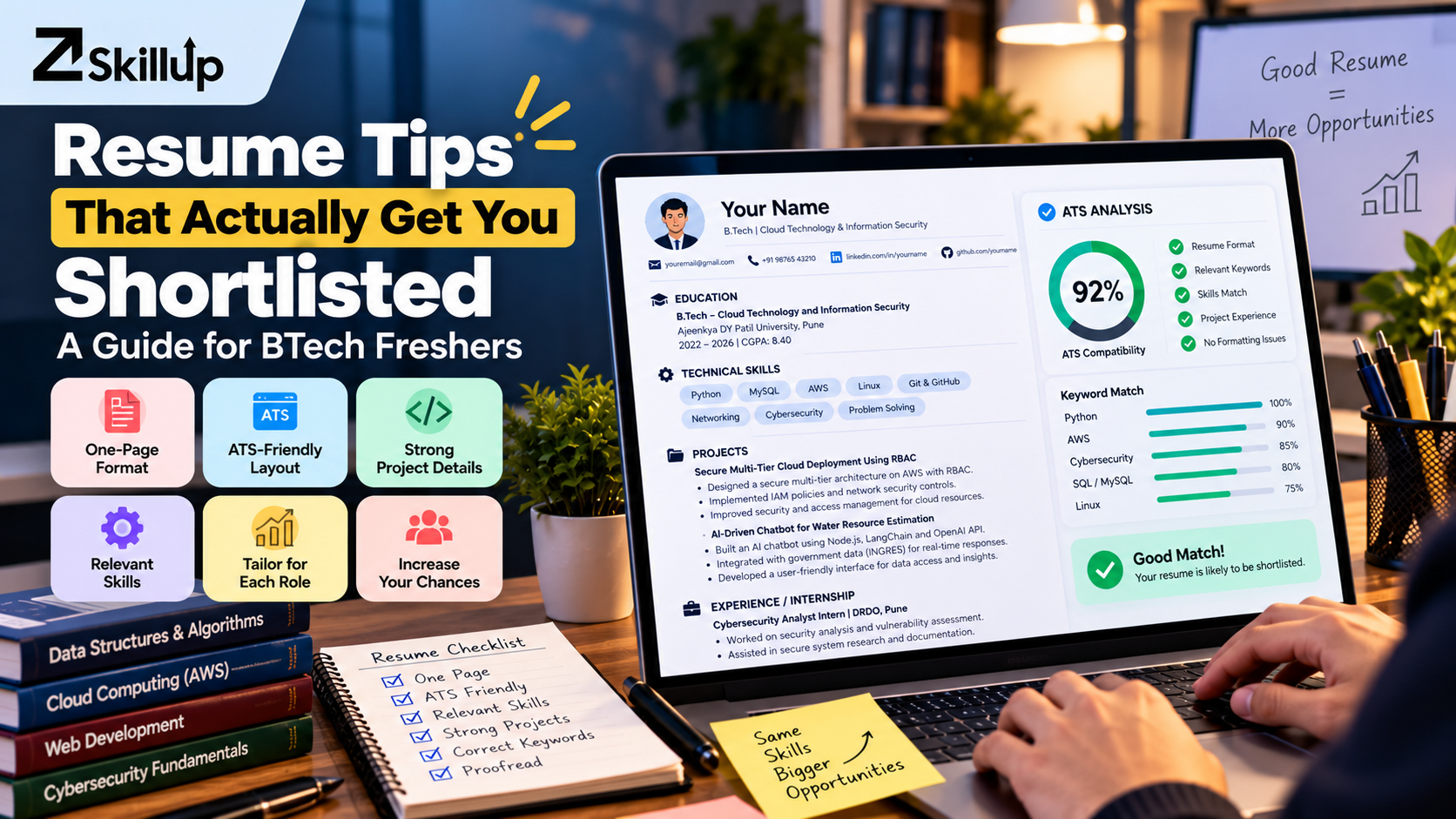
1. Keep It to One Page, in the Right Order
As a fresher, you usually don't need a second page. Everything a recruiter needs can fit on one page if you choose carefully and arrange your sections so your strongest evidence appears early.
Here is a recommended resume structure:
1. Header
Include your name, phone number, professional email address, and LinkedIn and GitHub links if they showcase relevant work.
2. Education
Mention your degree, branch, college, graduation year, and CGPA if it strengthens your application.
3. Technical Skills
Group your programming languages, frameworks, databases, cloud platforms and development tools by category.
4. Projects
Include two or three relevant projects, each with two or three concise bullet points explaining what you built, the technologies used and the results.
5. Internships and Experience
Mention your role, company, dates and key contributions. If you have relevant internship experience, consider placing this section above Projects.
6. Certifications and Achievements
Include certifications, hackathons, coding contests and recognised courses relevant to your target role.
Avoid generic career objectives, lengthy personal summaries, unnecessary school-level details and hobbies unrelated to the job. Every line should help the recruiter understand why you are a suitable candidate.
2. Make Your Resume ATS-Friendly
Many employers use an Applicant Tracking System (ATS) to organise and screen applications before a recruiter reviews them. Complicated formatting can make important information harder for these systems to interpret.
Follow these resume formatting tips:
- Use standard headings: Education, Skills, Projects and Experience are clearer than creative headings such as "My Journey."
- Stick to one column: Avoid complex tables, text boxes, graphics, icons and skill bars.
- Choose a common font: Calibri, Arial or Times New Roman in a readable 10–12 pt size are practical choices.
- Use relevant keywords honestly: Match terms from the job description, such as REST API, Python or MySQL, only when they accurately describe your experience.
- Submit the right file format: Use PDF unless the employer requests another format. Give the file a professional name, such as FirstName_LastName_Resume.pdf.
An ATS-friendly resume builder for freshers can simplify formatting, allowing you to focus on the quality of your content.
Remember that ATS optimisation is not about stuffing your resume with keywords. It is about presenting relevant qualifications clearly and accurately.
3. Show What You Built, Not Just What You Know
A skills list tells a recruiter what you have studied. Your project descriptions prove that you can apply those skills.
A strong project bullet follows this simple structure:
Action verb + What you built + Tools used + Result
Consider these examples:
Example 1: Python and SQL
Weak: "Knowledge of Python and SQL."
Stronger: "Built a Python expense tracker with a MySQL database to store and query more than 1,000 transactions."
Example 2: Web Development
Weak: "Worked on a web application."
Stronger: "Developed a React and Node.js event-booking application with login, search and seat-selection features."
Example 3: Machine Learning
Weak: "Completed a machine learning project."
Stronger: "Trained a logistic regression model using scikit-learn to classify spam emails, achieving 94% accuracy on a test set."
These examples illustrate how specific descriptions communicate practical skills more effectively. Use numbers only when they reflect your actual results. Never invent achievements or metrics, because interviewers may ask you to explain them.
If you have no internship experience, projects become especially important. Choose projects that match your target jobs, link to your GitHub repositories where appropriate, and prepare to explain your contribution, technical decisions and the hardest problem you solved.
4. Tailor Your Resume to Each Job Role
Sending the same resume to every company may seem efficient, but different roles look for different skills.
You don't need to rewrite your resume for every application. Spend around 10 minutes reviewing the job description and adjusting your existing resume to highlight the most relevant experience.
For service-based IT companies
Highlight programming fundamentals, problem-solving, databases, communication and teamwork.
For software developer and product roles
Prioritise coding projects, GitHub repositories, data structures and algorithms, and relevant development experience.
For data-related roles
Bring Python, SQL, data analysis projects and any dashboards or reporting tools you have used to the forefront.
Keep a master resume containing all your experience and projects. Create a tailored copy for each application by reordering skills, selecting relevant projects and using the employer's terminology where it accurately applies.
As part of your campus placement preparation, track the skills your target employers frequently request and ensure your resume provides evidence of those skills.
5. Make Your Projects and Experience Easy to Understand
Recruiters should not have to guess what your project does or what your contribution was.
For every project or internship, be ready to explain three things:
- The problem: What challenge were you trying to solve?
- Your contribution: What exactly did you build, improve or implement?
- The outcome: What changed because of your work?
Use clear action verbs such as Developed, Implemented, Automated, Tested, Analysed and Improved.
Avoid vague statements such as "Worked on various tasks" or "Responsible for project development." Explain the actual work you performed.
For team projects, distinguish your individual contribution from the team's overall achievements. This makes your experience easier to defend during technical interviews.
6. Check Your Resume Before Applying
Even a technically strong resume can lose credibility because of avoidable errors. Before submitting an application, review the following:
- Spelling and grammar: Correct typos, inconsistent capitalisation and unclear sentences.
- Contact information: Check that your phone number, email and profile links are accurate.
- Consistency: Use consistent date formats, bullet styles, spacing and headings.
- Relevance: Remove outdated or unrelated information that does not support your target role.
- Accuracy: Ensure that every skill, certification, project and achievement is genuine.
- Readability: Check that the resume remains clear when viewed on a computer screen or printed.
- File name: Use a professional filename instead of names such as Resume_Final_New_V3.pdf.
Read your resume from the recruiter's perspective. Can someone quickly understand your skills, strongest projects and suitability for the role? If not, simplify it.
Start Building a Stronger Resume with Prephasz
Creating a strong resume is an important part of preparing for campus placements and off-campus opportunities. Prephasz helps BTech students prepare for service-based IT company placements with resources designed to support their career journey.
You can use placement preparation resources to strengthen your fundamentals, practise coding and aptitude questions, prepare for interviews, and work on presenting your qualifications effectively.
A well-structured resume is only the first step. Combine it with consistent practice, relevant projects and the ability to explain your work confidently.
Final Thoughts
Getting shortlisted is not about having the longest resume or listing every technology you have ever studied. It is about showing relevant skills, practical experience and clear evidence of what you can contribute.
Keep your resume concise, use an ATS-friendly structure, describe projects with specific details, and tailor your application to each role.
Most importantly, be ready to explain everything you include. A truthful, focused resume supported by genuine skills will serve you far better than an impressive-looking document you cannot defend.
Start improving your resume today, and make every application count.
Put this into practice
Drill these exact patterns with adaptive practice, timed mocks and company-wise assessments on prephasz.
Start practising free