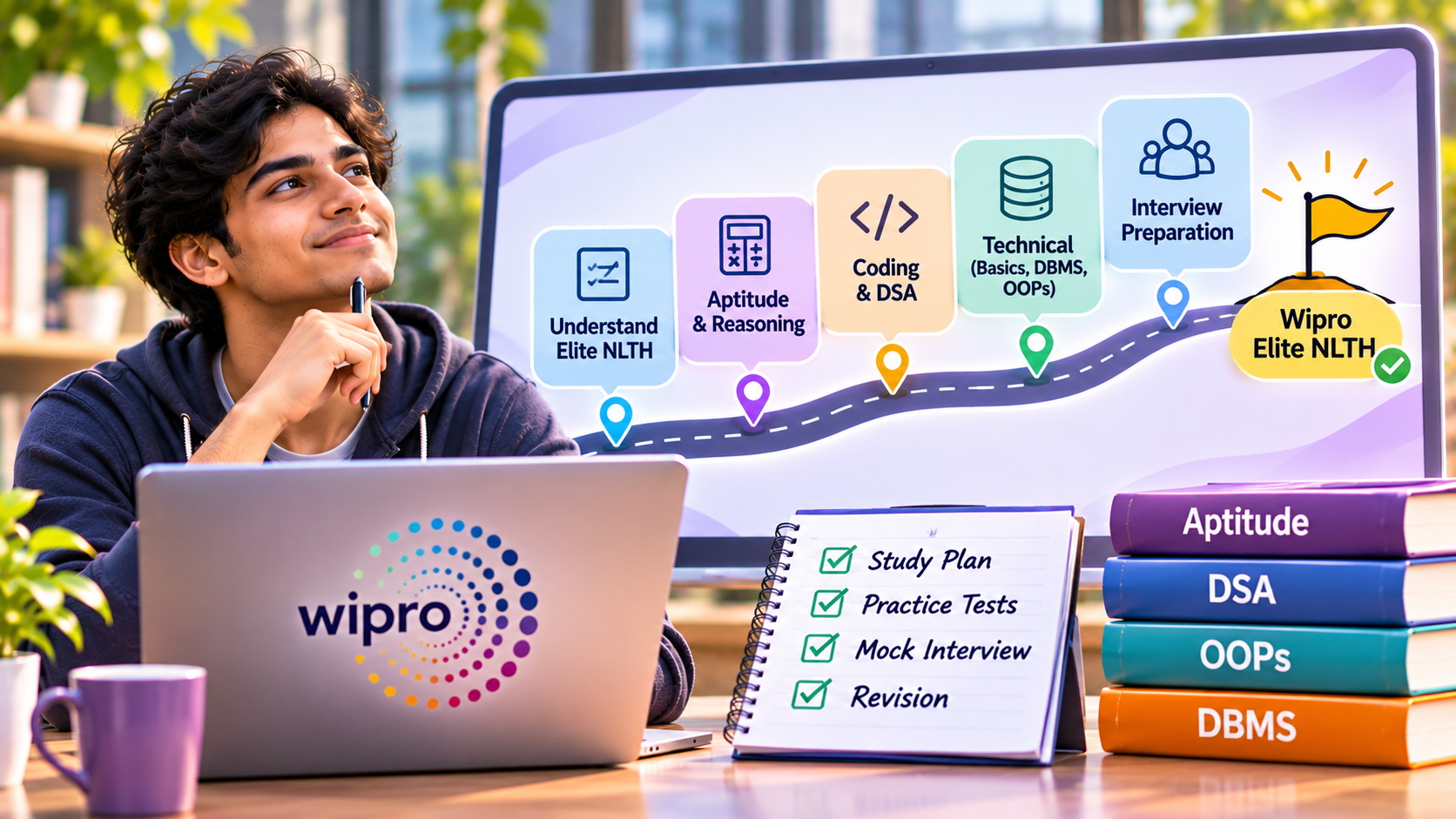

How to crack the TCS NQT in 2026? Learn the TCS NQT exam pattern, section weights, timing strategy and question types to prepare smarter and score higher.
Getting selected at Tata Consultancy Services (TCS) is a major career milestone for engineering freshers. However, cracking the TCS National Qualifier Test (NQT) requires a combination of aptitude, logical reasoning, verbal ability, and programming skills.
If you are a BTech student preparing for TCS placements in 2026, this guide will help you understand the test structure and prepare for every section systematically.
1. Understand the TCS NQT Exam Pattern
The TCS All India NQT hiring assessment has two broad sections: Foundation and Advanced.
The published 2026 hiring pattern specifies the following structure:
| Section | Topics | Duration |
|---|---|---|
| Foundation | Numerical Ability | 25 min |
| Foundation | Verbal Ability | 25 min |
| Foundation | Reasoning Ability | 25 min |
| Advanced | Advanced Quantitative & Reasoning | 25 min |
| Advanced | Advanced Coding | 90 min |
| Total | Foundation + Advanced | 190 min |
The Foundation section takes 75 minutes, while the Advanced section takes 115 minutes.
Candidates targeting Digital and Prime opportunities should pay particular attention to the Advanced section, which is mandatory for these higher hiring categories under the published recruitment pattern.
Always verify the latest recruitment notification for your specific batch before appearing for the test.
2. Numerical Ability: Build Speed and Accuracy
Numerical Ability tests your mathematical fundamentals and ability to solve problems within a time limit.
Prioritise these topics:
- Percentages, profit and loss
- Ratios and proportions
- Time, speed and distance
- Time and work
- Number systems
- Probability and permutations
- Averages and data interpretation
Regular quantitative aptitude practice online is essential. Pay particular attention to probability and permutations aptitude questions, as these help develop mathematical reasoning.
Learn useful logical reasoning shortcut tricks and practise questions under timed conditions.
Preparation tip: Solve 15–20 questions daily and maintain a notebook of formulas and mistakes.
3. Verbal Ability: Don't Underestimate English
Many students concentrate heavily on mathematics and coding while neglecting verbal ability.
Focus on:
- Reading comprehension
- Sentence correction
- Grammar and vocabulary
- Sentence completion
- Paragraph ordering
Regular verbal ability reading comprehension practice will improve reading speed and accuracy.
Preparation tip: Read English articles daily and solve timed grammar and comprehension exercises. Avoid spending too much time on a single question.
4. Reasoning Ability: Develop Your Problem-Solving Skills
Reasoning questions evaluate how effectively you identify patterns and solve unfamiliar problems.
Prepare these areas:
- Number and letter series
- Coding and decoding
- Blood relations
- Seating arrangements
- Logical puzzles
- Data sufficiency
- Visual and analytical reasoning
Practise different question types rather than repeatedly solving familiar ones.
An adaptive placement practice test can help identify your weaker reasoning topics and guide your revision.
5. Advanced Quantitative and Reasoning: Aim Higher
If you are targeting TCS Digital or Prime opportunities, the Advanced section deserves additional preparation.
Focus on complex arithmetic, analytical reasoning, multi-step problems, and questions that require combining multiple concepts.
Practise challenging company-specific placement papers and work on improving both speed and accuracy.
Preparation tip: Don't start with the toughest questions. Build confidence with moderate-level problems before moving to more complex ones.
6. Advanced Coding: The Most Important Preparation Area for Tech Aspirants
The Advanced Coding section gets 90 minutes in the published integrated assessment pattern.
This is where consistent programming practice can make a significant difference.
Start with one language, preferably C++, Java, or Python, and practise:
- Arrays and strings
- Sorting and searching
- Recursion
- Hashing
- Basic dynamic programming
- Mathematical programming problems
- Pattern-based problem solving
Solve DSA coding practice questions regularly. Don't just memorise solutions. Understand the logic, test edge cases, and learn to optimise your code.
Preparation tip: Practise at least one or two coding problems daily. Gradually increase the difficulty and simulate the actual 90-minute coding assessment.
7. Take Full-Length Mock Tests
Reading concepts is not enough. You need to practise under realistic examination conditions.
Take an online mock test for placement regularly. Use company-specific placement papers to understand the question styles and difficulty levels.
A timed custom mock test builder can help you create practice sessions covering individual sections or the entire assessment.
Review every test carefully. Identify whether you lost marks because of incorrect concepts, calculation errors, or poor time management.
8. Don't Forget the Interview Stage
Clearing the NQT assessment is an important step, but you should also prepare for subsequent interviews.
Revise programming fundamentals, object-oriented programming, DBMS, SQL, operating systems, and academic projects.
Practise common technical interview questions for freshers and learn how to crack technical interview for tech jobs by explaining your approach clearly.
An AI mock interview online can help you practise technical discussions and improve your confidence.
Also prepare a concise answer to "Tell me about yourself" and be ready to explain every project mentioned in your resume.
Use an ATS friendly resume builder for freshers and follow freshers resume formatting tips for ATS to create a clean, preferably one-page resume.
Your TCS NQT Preparation Starts with Prephasz
Cracking the TCS NQT requires consistency across aptitude, reasoning, verbal ability, and coding. Don't restrict your preparation to the Foundation section if your ambition is to qualify for higher technical roles.
Prephasz helps BTech students prepare for service-based IT company placements through company-specific learning materials, videos, practice tests, mock interviews, and a resume builder.
Start your TCS NQT preparation today. Practise every section, track your progress, strengthen your coding skills, and move one step closer to your first technology job!
Put this into practice
Drill these exact patterns with adaptive practice, timed mocks and company-wise assessments on prephasz.
Start practising free