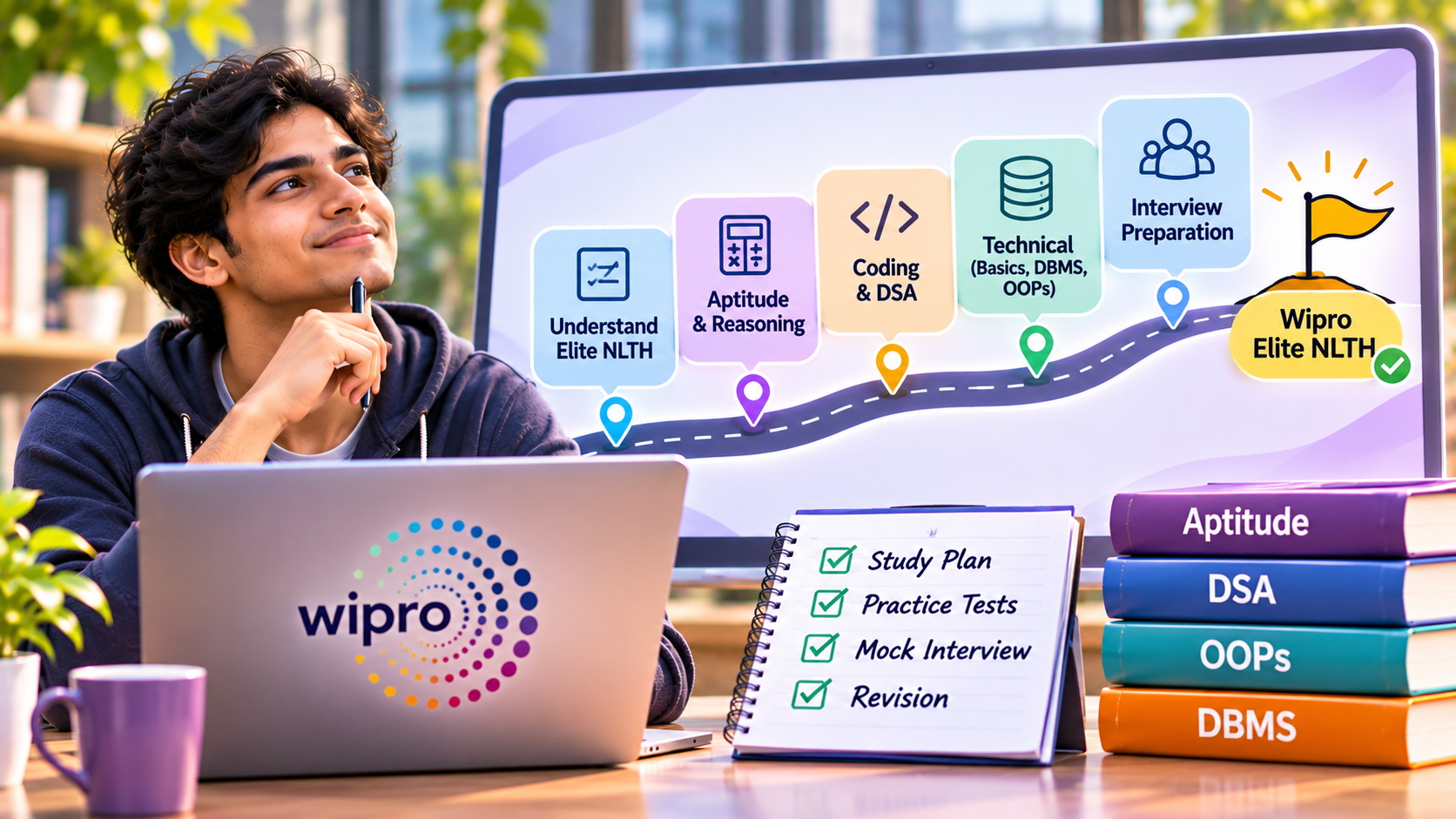

Decode the Accenture assessment pattern for freshers. Learn about cognitive, technical, coding and communication rounds with a section-wise preparation strategy.
The Accenture Assessment Pattern, Decoded: A Complete Guide for BTech Freshers (2026)
Preparing for Accenture placements? Before you start solving hundreds of aptitude and coding questions, understand what the assessment actually tests.
Accenture's fresher recruitment process evaluates more than just programming knowledge. It looks at your logical thinking, numerical ability, technical fundamentals, coding skills, and communication.
The good news is that with the right preparation strategy, you can approach every section confidently.
Here is a breakdown of the Accenture assessment and how to prepare for it.
1. Understand the Accenture Assessment Structure
Accenture's recruitment assessments vary depending on the hiring programme, role, and campus drive.
A commonly reported campus recruitment structure includes the following stages:
| Assessment stage | What it evaluates |
|---|---|
| Cognitive assessment | Numerical ability, verbal ability, logical and abstract reasoning |
| Technical assessment | Pseudocode, programming fundamentals, networking, cloud and security |
| Coding assessment | Programming logic and problem-solving |
| Communication assessment | Grammar, vocabulary, pronunciation and fluency |
| Interview | Technical knowledge, projects and behavioural skills |
Some campus drives combine cognitive and technical assessments, while others conduct them separately.
For example, one published HirePro recruitment process describes a 90-minute combined cognitive and technical assessment, followed by a 45-minute coding assessment and a separate communication assessment.
Important: Do not assume every Accenture drive follows this exact sequence or timing. Your official assessment invitation is the final reference.
2. Cognitive Assessment: Test Your Thinking Skills
This section evaluates your ability to understand information, identify patterns, and solve problems quickly.
Prepare three major areas:
Numerical Ability
- Percentages and ratios
- Averages
- Profit and loss
- Time and work
- Probability
- Data interpretation
Logical and Abstract Reasoning
- Number and letter series
- Puzzles
- Coding-decoding
- Pattern recognition
- Analytical reasoning
Verbal Ability
- Reading comprehension
- Sentence correction
- Grammar
- Vocabulary
- Sentence completion
Regular quantitative aptitude practice online can improve your calculation speed. Learn useful logical reasoning shortcut tricks and practise probability and permutations aptitude questions.
Don't neglect verbal ability reading comprehension practice. Accuracy matters just as much as speed.
3. Technical Assessment: Know Your Fundamentals
The technical assessment checks whether you understand the concepts required for entry-level technology roles.
Prioritise these topics:
- Programming fundamentals
- Object-oriented programming
- Pseudocode and output prediction
- Database management systems
- Computer networks
- Cloud computing
- Cybersecurity fundamentals
- Common applications and MS Office
Include DBMS and SQL technical MCQ practice in your daily preparation.
Pay special attention to pseudocode questions. You should be comfortable tracing loops, conditional statements, arrays, functions, and nested structures.
4. Coding Assessment: Demonstrate Your Programming Skills
This is an important stage for students targeting Accenture's technology roles.
Choose a programming language you are comfortable with, such as Java, Python, C++, or C.
Focus on these topics:
- Arrays and strings
- Sorting and searching
- Number-based problems
- Loops and functions
- Basic data structures
- Recursion
- Hashing
- Pattern-based problems
Practise DSA coding practice questions every day.
Start with easy problems and gradually move towards medium-level questions. Focus on writing correct code, testing edge cases, and understanding time complexity.
For reported campus formats involving two coding questions in 45 minutes, practise allocating time carefully rather than spending the entire session on one problem.
5. Communication Assessment: Don't Ignore Your English Skills
Many technically strong students underestimate the communication assessment.
Depending on the drive, this section can evaluate:
- Pronunciation
- Fluency
- Vocabulary
- Grammar
- Listening comprehension
- Sentence formation
Practise reading English passages aloud, listening to short audio clips, and speaking on familiar topics.
Record yourself answering questions and identify unnecessary pauses, unclear pronunciation, and filler words.
The objective is not to speak with a particular accent. It is to communicate clearly and confidently.
6. Prepare for the Accenture Interview
Clearing the online assessments is an important milestone, but you should also prepare for the interview.
Revise your programming language, OOPs, DBMS, SQL, and academic projects.
Prepare common technical interview questions for freshers and practise explaining your coding solutions.
An AI mock interview online can help you improve your confidence and structure your responses.
Pay particular attention to:
- Tell me about yourself.
- Explain your final-year project.
- What programming language are you comfortable with?
- Explain OOPs concepts.
- Write a basic SQL query.
- Describe a technical challenge you solved.
Understanding how to crack technical interview for tech jobs requires both subject knowledge and the ability to communicate your thought process.
7. Your 14-Day Accenture Preparation Plan
If your placement assessment is approaching, follow this focused schedule.
| Days | Preparation focus |
|---|---|
| 1–3 | Quantitative aptitude and logical reasoning |
| 4–5 | Verbal ability and communication |
| 6–7 | Programming fundamentals and pseudocode |
| 8–9 | DBMS, SQL, networking and cloud basics |
| 10–11 | DSA coding practice questions |
| 12 | Full-length placement mock test |
| 13 | Technical and communication mock interviews |
| 14 | Revision and final practice assessment |
Take an online mock test for placement regularly. An adaptive placement practice test can help identify weaker topics.
Practise company-specific placement papers and use a timed custom mock test builder to simulate assessment conditions.
If you are preparing for multiple service-based IT companies, include TCS NQT preparation 2026 in your broader campus placement preparation strategy.
Start Your Accenture Preparation with Prephasz
Cracking Accenture's assessment requires preparation across aptitude, technical fundamentals, coding, and communication.
Prephasz brings together company-specific videos, reading materials, practice tests, mock interviews, and a resume builder to help BTech students prepare for service-based IT company placements.
Use an ATS friendly resume builder for freshers and follow these freshers resume formatting tips for ATS: keep your resume concise, preferably one page, highlight relevant projects, and use standard section headings.
Don't prepare randomly. Understand the assessment, practise each section, and track your progress. Start your Accenture placement preparation with Prephasz today!
Put this into practice
Drill these exact patterns with adaptive practice, timed mocks and company-wise assessments on prephasz.
Start practising free