
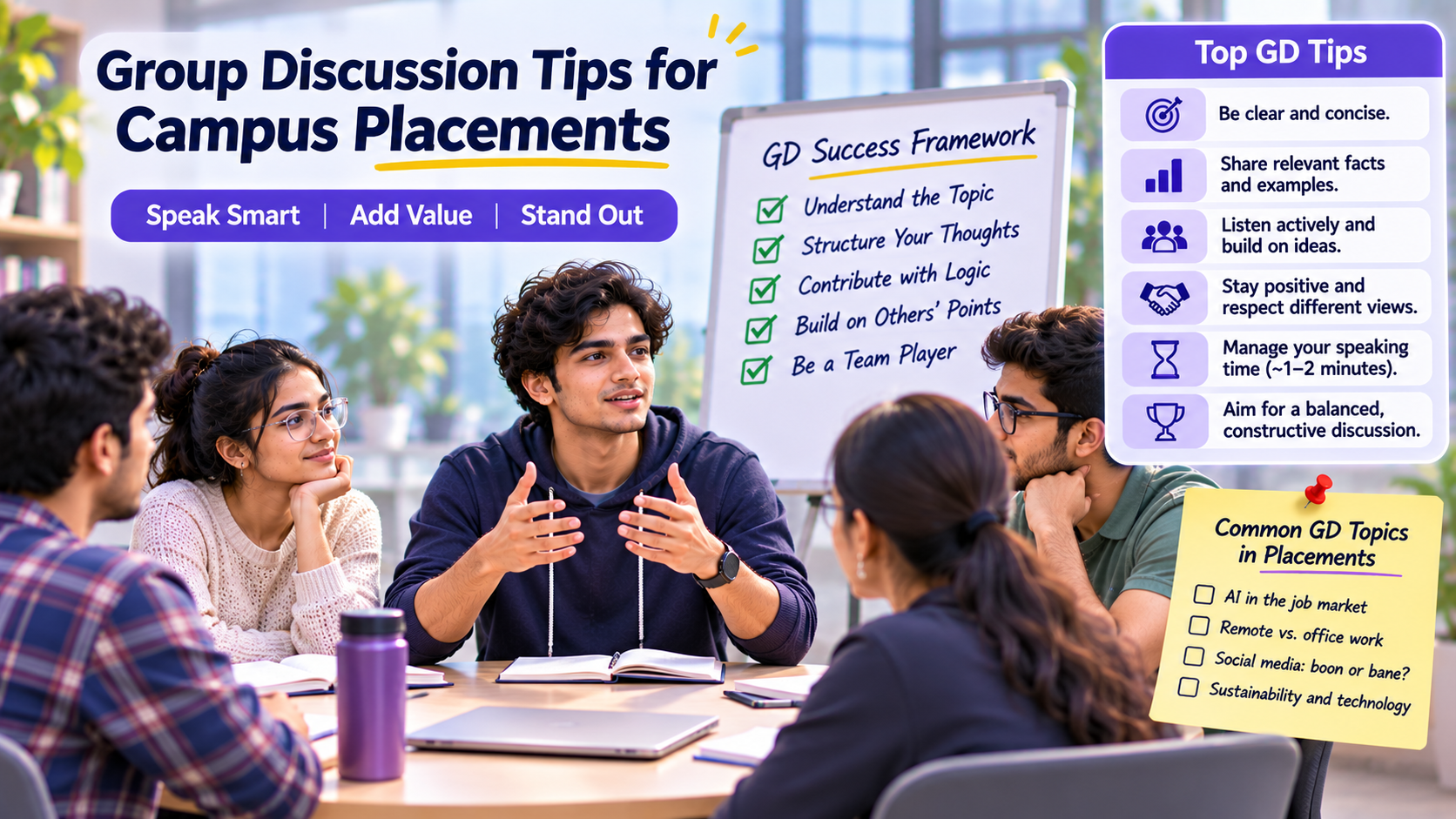
Learn how to crack group discussions in campus placements with practical GD tips, common topics, sample answers and a 7-day preparation plan for BTech freshers.
Group Discussion Tips for Campus Placements: How to Stand Out as a Fresher
You have cleared the aptitude test and technical assessment. Now comes the Group Discussion (GD) round, where you need to express your ideas confidently in front of other candidates.
For many BTech freshers, group discussions can be intimidating. Should you speak first? How often should you contribute? What if someone interrupts you?
The good news is that cracking a group discussion is not about speaking the most. It is about adding the most value.
Here are seven practical tips to help you perform better in your next campus placement GD.
1. Understand What Recruiters Evaluate
Group discussions are designed to assess more than your knowledge of a topic.
Recruiters typically look for:
- Communication skills and clarity of thought
- Logical reasoning and analytical ability
- Active listening
- Teamwork and collaboration
- Confidence and professionalism
- Ability to handle disagreements
Remember, a GD is not a debate you must win. It is an opportunity to demonstrate how effectively you contribute to a team discussion.
2. Should You Speak First?
Starting a group discussion can help you make a positive first impression, but only if you understand the topic.
If you are confident, begin with a brief introduction that defines the topic and establishes a direction for the discussion.
For example, if the topic is "Will Artificial Intelligence Replace Software Engineers?", you could say:
"Artificial intelligence is changing how software is developed, but rather than completely replacing engineers, it may transform their responsibilities. Let's consider both the opportunities and challenges."
If you are unfamiliar with the topic, listen to a few participants before contributing.
Speaking first is optional. Speaking meaningfully is essential.
3. Follow the Point–Reason–Example Framework
One of the easiest ways to structure your contribution is the PRE framework:
- Point: Clearly state your opinion.
- Reason: Explain why you believe it.
- Example: Support it with a relevant example.
For instance, if the discussion is about remote work:
"Remote work can improve productivity for certain technology roles because it reduces commuting time and allows greater flexibility. For example, developers working on independent tasks may benefit from uninterrupted focus time."
Keep your contributions concise and relevant.
4. Listen Actively and Build on Others' Ideas
A common mistake freshers make is focusing only on what they want to say.
Good communication also involves listening.
Use phrases such as:
- "I agree with that point, and I would like to add..."
- "That's an interesting perspective. Another factor worth considering is..."
- "I see your point, but I have a slightly different view..."
Acknowledging others demonstrates teamwork and maturity.
Avoid interrupting, speaking over others, or dismissing opposing opinions.
5. Don't Dominate the Discussion
Speaking continuously does not guarantee selection.
Instead, aim for three or four meaningful contributions during a typical GD, adjusting to the duration and group size.
Try to contribute in different ways:
- Introduce a new perspective.
- Support an argument with an example.
- Clarify a confusing point.
- Connect two different viewpoints.
- Summarise the discussion if the opportunity arises.
Quality matters more than quantity.
6. Prepare Common GD Topics for Placements
Students should practise discussing current issues, technology trends, and workplace-related topics.
Popular practice topics include:
- Will AI replace software engineers?
- Work from home vs. work from office
- Is social media a boon or a bane?
- Should coding be compulsory for all engineering students?
- Is India ready for a fully digital economy?
- Are startups better career options than large IT companies?
- Will automation create more jobs than it eliminates?
- Should college education focus more on practical skills?
Read about these topics, understand different perspectives, and practise presenting balanced arguments.
7. Practise with a Group and Record Yourself
The best way to improve your GD performance is through regular practice.
Form a group of four to six friends and select a topic.
Conduct a 10–15-minute discussion and record the session.
Review your performance:
- Did you speak clearly?
- Were your points relevant?
- Did you interrupt others?
- Did you maintain confident body language?
- Did you listen and respond appropriately?
Identify one or two improvements after each practice session.
You can also use an AI mock interview online to practise explaining opinions, answering follow-up questions, and improving your communication skills. However, practising with a real group is especially valuable for developing listening and turn-taking skills.
A Simple 7-Day GD Preparation Plan
| Day | Activity |
|---|---|
| Day 1 | Understand GD evaluation criteria and watch sample discussions |
| Day 2 | Practise speaking for one minute on five topics |
| Day 3 | Learn the Point–Reason–Example framework |
| Day 4 | Participate in a mock group discussion |
| Day 5 | Practise handling disagreements and interruptions |
| Day 6 | Record and review another group discussion |
| Day 7 | Conduct a final mock GD and evaluate improvements |
Prepare for Campus Placements with Prephasz
Group discussions are an important part of some campus recruitment processes, but not every IT company includes a GD round.
Alongside GD preparation, strengthen your campus placement preparation with aptitude practice, coding questions, and technical interviews.
Prephasz helps BTech students prepare for service-based IT company placements through company-specific learning materials, online mock tests, interview practice, and a resume builder.
Remember: You don't need to be the loudest person in the room. Be the person who listens, thinks clearly, and adds value to the conversation.
Start preparing with Prephasz today and approach your next placement round with confidence!
Put this into practice
Drill these exact patterns with adaptive practice, timed mocks and company-wise assessments on prephasz.
Start practising free