Avoid the most common tech interview mistakes with practical tips to improve confidence, communication, and problem-solving for better results.
Your first tech interview is rarely lost on talent. It is usually lost on preparation: a slow aptitude round, a coding question you knew but froze on, or a project you couldn't explain.
The fix is a plan. This guide walks you through each stage of a typical fresher hiring process, from the online test to the HR round, with what to practise, how much time to give it, and the mistakes that cost candidates offers. It is written for BTech students preparing for campus placements and off-campus drives at service-based IT companies, though most of it applies to any entry-level tech role.
1. Know What You're Preparing For
Most entry-level hiring processes follow four stages, though the order, cut-offs and question mix vary by company and role. Check each target company's recent pattern before you start, so you spend your hours where they count.
| Stage | What It Tests | What Usually Trips Freshers Up |
|---|---|---|
| Online assessment | Aptitude, reasoning, verbal ability, sometimes basic coding | Running out of time, not accuracy |
| Coding round | Problem solving in a language of your choice | Not handling edge cases or input format |
| Technical interview | CS fundamentals, your projects, live problem solving | Vague project explanations |
| HR interview | Communication, attitude, fit, flexibility | Rehearsed, generic answers |
A quick rule: if a stage eliminates the most candidates at your target companies, it deserves the most practice time.
2. Build Speed in Aptitude, Not Just Accuracy
Aptitude rounds are timed tightly, so the goal is solving familiar questions fast enough to leave time for hard ones. Cover the three areas below, then practise them under a timer.
- Quantitative aptitude: percentages, ratios, profit and loss, time and work, time-speed-distance, averages, and probability and permutations. Learn the standard formula for each topic first, then drill 15–20 questions a day.
- Logical reasoning: series, coding-decoding, blood relations, seating arrangements, syllogisms and data interpretation. Shortcut tricks help, but only once you understand why they work.
- Verbal ability: reading comprehension, sentence correction and vocabulary in context. Reading one editorial a day builds speed for comprehension passages faster than any question bank.
Track your time per question. If a topic takes you more than twice your average, that is where your next week of practice should go.
3. Take Mock Tests Like the Real Thing
A mock test is only useful if it feels like the actual assessment. Sit it in one go, with a timer, no phone and no pausing.
- Start with a baseline. Take one full-length placement mock test before you begin serious preparation. Your score tells you which sections need the most work.
- Practise company-specific papers. Each employer has its own pattern. If you are targeting TCS, for example, practise TCS NQT-style papers covering aptitude, reasoning, verbal ability and coding.
- Use adaptive or custom tests for weak areas. Build shorter timed tests around the topics where you lose the most marks.
- Review every mistake. Spend as long reviewing a test as taking it. Note whether each wrong answer came from a concept gap, a careless slip or running out of time, because each needs a different fix.
Aim for at least one full mock test a week, rising to two or three in the month before placements.
4. Master Coding and CS Fundamentals
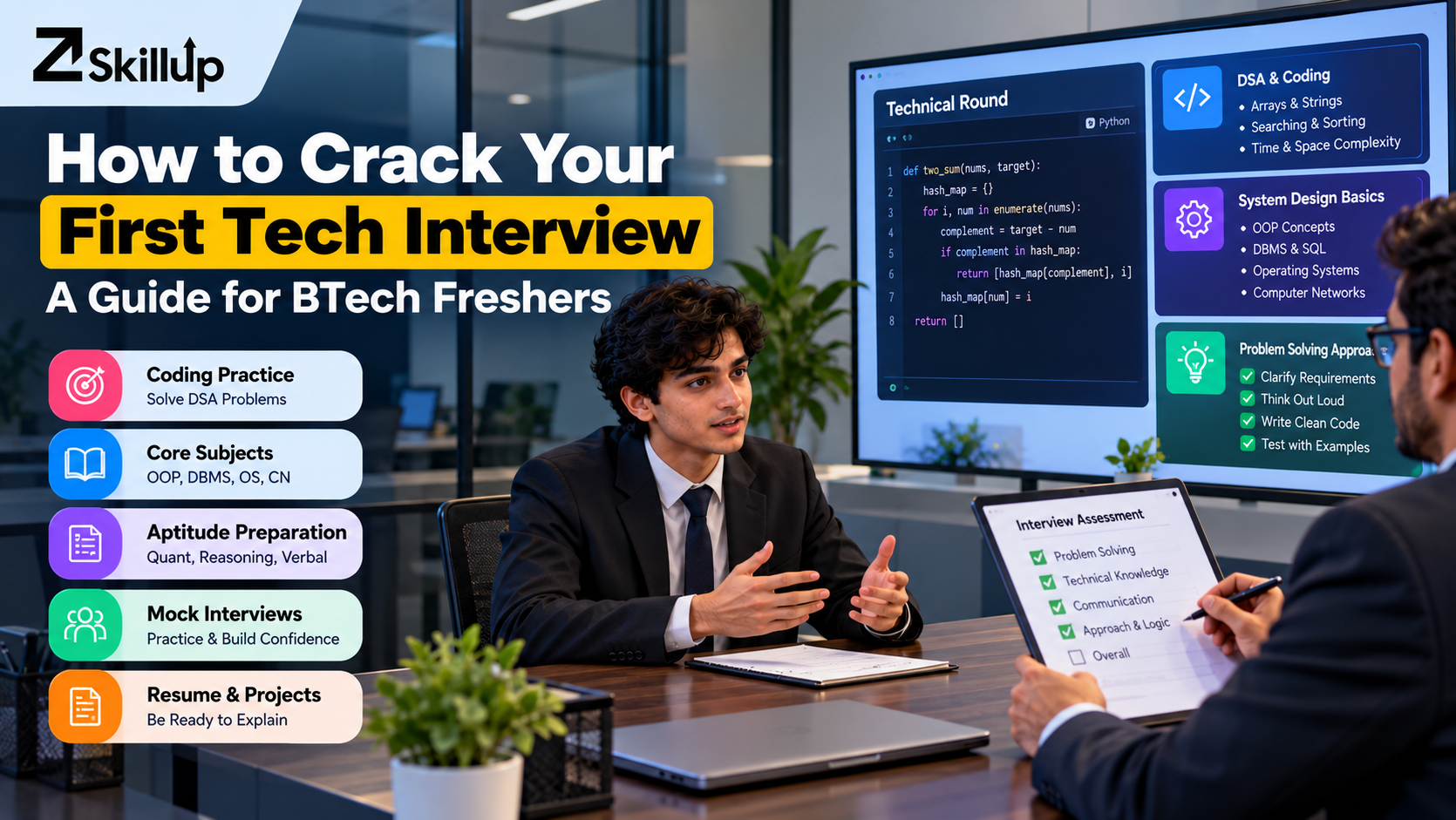
You don't need competitive-programming skills for most fresher roles. You do need to write working code for common problems and explain your thinking while you do it.
Pick one language and go deep. C++, Java or Python are all fine. Interviewers care more that you know one language well than that you list four.
Cover the core DSA topics. Arrays, strings, sorting, searching, linked lists, stacks, queues, hashing and basic recursion cover most fresher coding questions. Solve 2–3 problems a day, and for each one, check edge cases: empty input, a single element, duplicates and very large values.
Revise the four CS subjects interviewers ask about most:
- OOP: classes, objects, inheritance, polymorphism, encapsulation and abstraction, each with a real-world example.
- DBMS and SQL: keys, joins, normalisation, indexing, and writing queries with GROUP BY and subqueries.
- Operating systems: processes vs threads, scheduling, deadlocks and memory management.
- Computer networks: the OSI and TCP/IP models, HTTP vs HTTPS, DNS and what happens when you type a URL.
Talk through your approach before you code. Say how you plan to solve the problem, write the solution, then walk through a test case. An interviewer who can follow your reasoning will often help you past a small mistake. One who sees silent typing cannot.
5. Build an ATS-Friendly Resume You Can Defend
Many companies screen resumes through an applicant tracking system (ATS) before a person reads them. A fresher resume should be one page, easy for software to parse, and honest enough that you can discuss every line.
- Use standard headings: Education, Skills, Projects, Internships, Certifications, Achievements.
- Keep the formatting simple: one column, a common font, no tables, icons or text inside images.
- Match keywords to the role: if the job description mentions Java, SQL or REST APIs and you have used them, name them exactly.
- Describe projects by outcome: what you built, the tools you used, your specific part, and a result, such as "cut page load time from 4s to 1.5s".
- Cut anything you can't explain: if a skill is listed, expect a question on it.
If you have an internship, treat it as a long interview. Ask for feedback early, take ownership of a clear piece of work, and keep a record of measurable results. That is the strongest case for a pre-placement offer (PPO).
6. Practise the Interview Out Loud
Reading answers is not the same as saying them. Practise speaking, whether with a friend, a senior, or an AI mock interview tool, and record yourself at least once.
Prepare a 60-second introduction. Cover your degree and college, your strongest technical skills, one project you are proud of, and the kind of role you want. Skip your full life story and anything already obvious from your resume header.
Know each project inside out. Be ready to answer:
- Why did you build it?
- What was your part?
- What was the hardest problem, and how did you solve it?
- What would you do differently now?
Prepare for common HR questions. Expect "Why should we hire you?", "Are you open to relocation?", "Where do you see yourself in five years?" and "Tell me about a time you worked in a team." Answer with a short, real example rather than a list of adjectives.
Have a question ready for them. Asking about the training programme or the first project new joiners work on shows genuine interest.
7. A Sample Weekly Plan (About 2 Hours a Day)
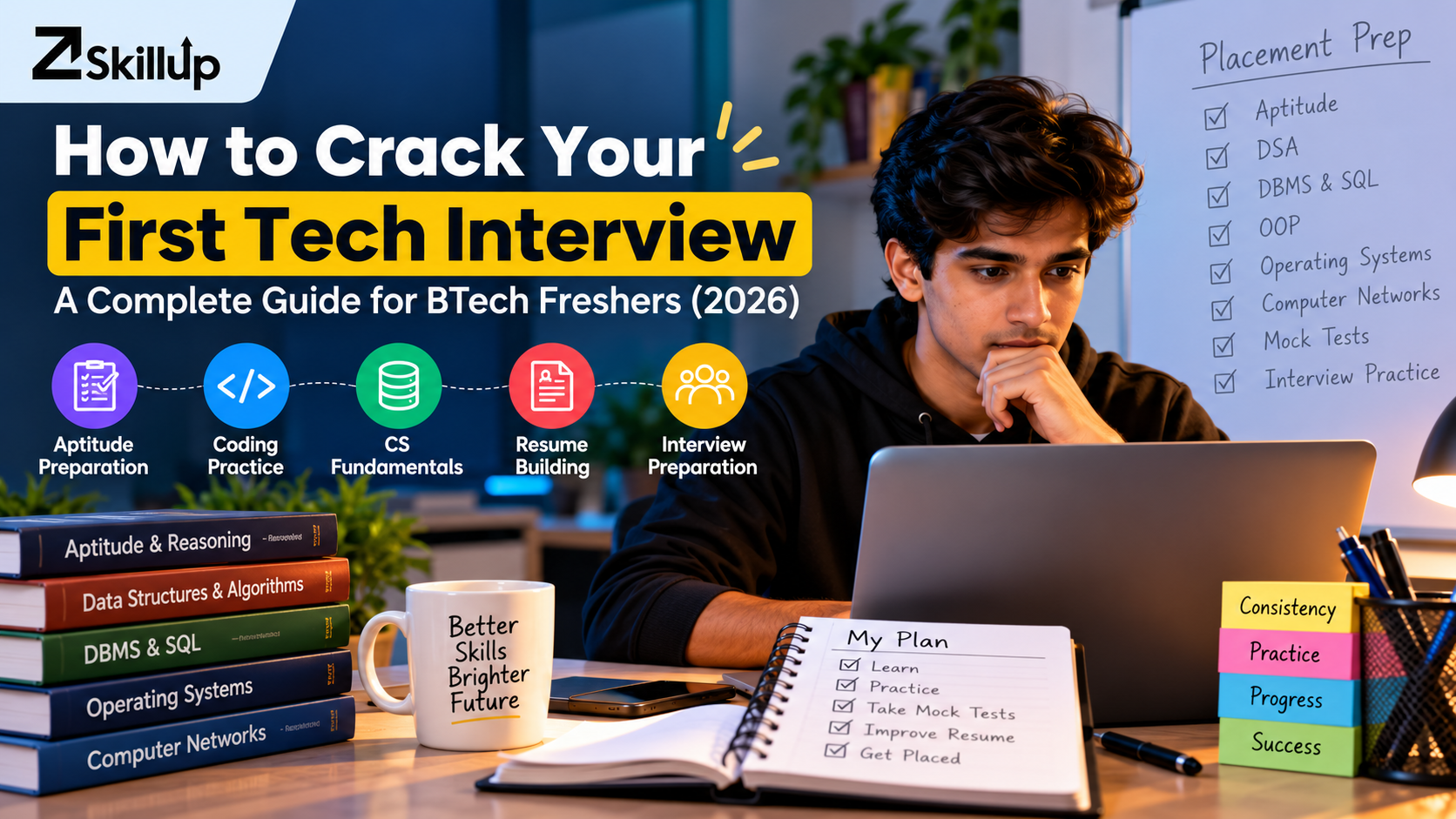
Consistency beats long weekend sessions. Here is one way to split a week alongside college; adjust the mix based on your mock test scores.
| Day | Focus (About 2 Hours) |
|---|---|
| Monday | Quant aptitude (1 hr) + 2 coding problems (1 hr) |
| Tuesday | Logical reasoning (1 hr) + DBMS and SQL revision (1 hr) |
| Wednesday | Verbal ability (45 min) + 2–3 coding problems (75 min) |
| Thursday | OOP and OS revision (1 hr) + 2 coding problems (1 hr) |
| Friday | Computer networks (45 min) + project and resume prep (75 min) |
| Saturday | Full-length timed mock test + review of mistakes |
| Sunday | Mock interview (intro, projects, HR) + rest |
8. Mistakes That Cost Freshers Offers
- Starting too late. Aptitude speed takes weeks to build. Begin at least two to three months before your first drive.
- Only reading, never timing. Untimed practice hides your real weakness: speed.
- Memorising answers. Interviewers change one detail and ask why. Understand the concept instead.
- Listing skills you can't explain. One unanswerable question about your own resume does more damage than a short skills list.
- Going silent while coding. Thinking aloud lets the interviewer see your problem-solving, even when the code isn't perfect.
- Skipping the review. A mock test without a review only tells you your score, not how to improve it.
Prepare in One Place with Prephasz
Prephasz is built for BTech students preparing for service-based IT company placements. It brings together everything in this guide:
- Company-specific videos and reading materials.
- Aptitude, reasoning, verbal and coding tests, including timed mock tests.
- AI-powered mock interviews for technical and HR rounds.
- An ATS-friendly resume builder for freshers.
Your first tech interview is a chance to show what you know and how you think. Start practising with Prephasz today, stay consistent, and walk into your first interview prepared.
Put this into practice
Drill these exact patterns with adaptive practice, timed mocks and company-wise assessments on prephasz.
Start practising free