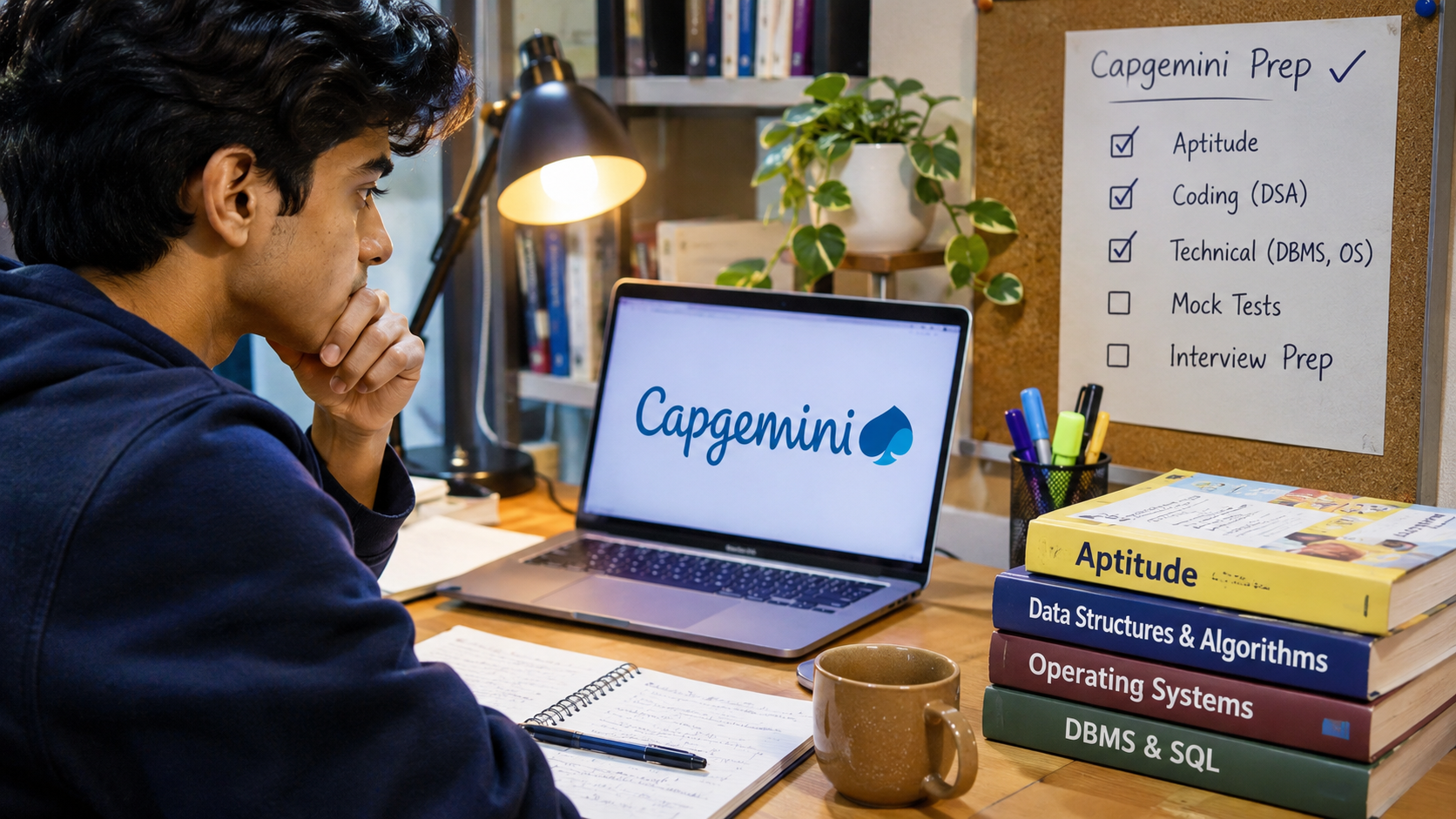
The Capgemini placement process typically includes an online test, technical interviews, and HR interviews. This guide covers everything you need - job roles, preparation strategy, and interview rounds for Capgemini campus placement.
Capgemini is one of the most popular recruiters for BTech freshers, but its hiring process catches many students off guard. Instead of a standard aptitude paper, you may face short brain games, a pseudocode section and an English test, and your scores decide which of two offer tracks you are considered for.
If you are preparing for Capgemini placements in 2027, this guide explains how the process works and what to practise for each stage.
1. Analyst vs Senior Analyst: the two offer tracks
Capgemini's fresher hiring in 2027 has been reported to offer two tracks. You don't apply to them separately; your assessment and interview performance decide which one you're considered for.
| Analyst | Senior Analyst | |
|---|---|---|
| Reported Package | About ₹4–4.5 LPA | About ₹6.5–7.5 LPA |
| Selection bar | Standard assessment cutoffs and technical interview | Higher cutoffs, usually a coding round and a more advanced technical interview |
Packages, eligibility (such as minimum percentages and backlog rules) and the exact pattern can change between drives. Always check your campus notification or official Capgemini communication.
Our advice: prepare for the Senior Analyst bar. The extra coding practice costs you nothing at the Analyst level, and it makes you a stronger candidate everywhere else.
2. How the selection process works
Recent Capgemini drives have followed this broad flow, though the order and sections can vary:
Registration through your college placement cell or the Capgemini careers portal.
Online assessment, usually with sections such as pseudocode, quantitative aptitude, game-based aptitude and English communication. Sectional cutoffs often apply.
Coding round, mainly for candidates being considered for Senior Analyst.
Technical interview on programming, CS fundamentals and your projects.
HR interview on communication, attitude and fit.
The online assessment is the main elimination stage, so the next three sections focus on it. Many students lose out because they prepare only for quantitative aptitude and ignore pseudocode, the games or English.
3. Game-based aptitude and quantitative aptitude
Game-based aptitude replaces a traditional logical reasoning paper with a series of short online games. They test skills like memory, pattern recognition, logic, attention and switching between changing rules. You can't memorise answers, but you can get comfortable with the format:
Read each game's instructions fully and use the practice round if one is offered.
Focus on accuracy first; speed improves with familiarity.
Practise puzzles, pattern and sequence questions, and logical reasoning shortcut tricks to sharpen the same thinking.
Take the test somewhere quiet. Games that test attention punish distractions.
Quantitative aptitude still matters. Cover percentages, ratios, profit and loss, time and work, time-speed-distance, averages, and probability and permutations. Regular quantitative aptitude practice online, under a timer, builds the speed you'll need.
4. Pseudocode and coding
Pseudocode is one of Capgemini's most distinctive sections, and one where many students drop marks. You'll read short snippets of language-neutral code and work out what they do. Practise:
Tracing loops and nested loops by hand
Following conditions, recursion and function calls
Predicting output, including with operators like modulo and bitwise operations
Basic data structures, OOP concepts and C fundamentals, which often appear in technical MCQs
The best preparation is writing out variable values line by line on paper until tracing becomes quick.
Coding matters most if you're aiming for Senior Analyst. Expect a couple of easy-to-medium problems. Practise DSA coding questions on arrays, strings, sorting, searching, hashing and recursion, in C, C++, Java or Python. For every solution, test edge cases and be ready to explain its time and space complexity.
5. English communication
The English section is easy to underestimate, but sectional cutoffs mean a weak score here can end your application. Expect questions on grammar, vocabulary, sentence correction and reading comprehension.
Verbal ability reading comprehension practice for 15–20 minutes a day is enough for most students. Reading one newspaper editorial daily also builds the speed and vocabulary that comprehension passages demand.
Then put it all together with mock tests. Take an online mock test for placement in a Capgemini-style format early on to find your weak sections. Use company-specific placement papers, adaptive practice tests and a timed custom mock test builder to drill those sections under real time pressure.
6. Technical and HR interviews
Once you clear the assessment, interviews decide your offer, and strong performance can count towards the higher track.
Technical interview. Expect questions on your main programming language, OOP, DBMS and SQL, operating systems, basic DSA and, above all, your projects. Be ready to explain what you built, why you chose your tech stack, the hardest problem you faced and what you would improve. Practise technical interview questions for freshers out loud, and explain your approach before giving an answer.
HR interview. Prepare a 60–90 second introduction, and answers to common questions such as:
Why do you want to join Capgemini?
Are you comfortable relocating or working in shifts?
What are your strengths and weaknesses?
Where do you see yourself in a few years?
Know the basics about Capgemini: what it does, its main services and anything recent worth mentioning. An AI mock interview tool or a friend can help you practise until your answers sound natural.
7. Create a strong fresher resume
Your resume shapes your technical interview, so make every line count. Follow these freshers resume formatting tips for ATS:
Keep it to one page, with standard headings and a single-column layout.
Put your programming languages and technical skills near the top.
Include two or three projects, each showing what you built, the tools used and the result.
Add internships and certifications where relevant.
Leave out any skill you can't confidently explain.
An ATS-friendly resume builder for freshers can handle the formatting, so you can focus on the content.
Start your Capgemini preparation with Prephasz
Cracking Capgemini means preparing for every section, not just aptitude: games, pseudocode, English, coding and interviews.
Prephasz helps BTech students prepare for service-based IT company placements with company-specific videos, reading materials, practice tests, mock interviews and a resume builder.
Don't wait for your drive to be announced. Start preparing with Prephasz today, practise consistently, and aim for the Senior Analyst bar.
Put this into practice
Drill these exact patterns with adaptive practice, timed mocks and company-wise assessments on prephasz.
Start practising free