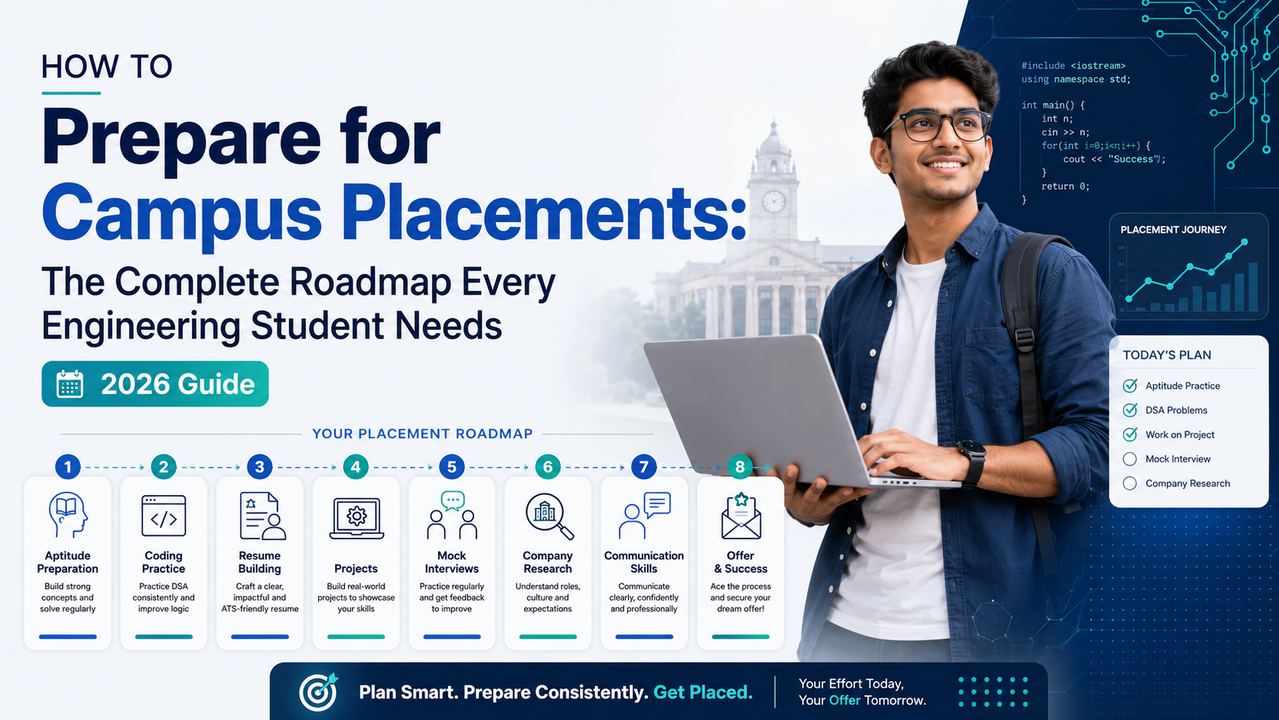
How to Prepare for Campus Placements: The Complete Roadmap Every Engineering Student Needs (2026 Guide)
It's 9 AM. Three hundred students sit in the college auditorium, laptops open, all chasing the same dream: a first job offer.
The Training and Placement Officer announces the start of the online assessment. For ninety minutes, the only sound in the room is typing.
Then the results come in, and only a handful of names make it to the next round.
Here's the part that surprises everyone: most of the students who didn't clear it weren't lazy. They attended every class, watched the aptitude videos, solved coding questions, downloaded every placement PDF they could find. Some had been "preparing" for months.
So why didn't it work? Not because they lacked intelligence, but because they prepared without a plan.
That gap, effort without direction, is the biggest problem facing engineering students today. The internet has made placement prep easier than ever, and in the same breath, more confusing than ever. Search "how to prepare for campus placements" and you're buried under thousands of videos, coding sheets, Telegram groups, and websites all claiming to be the definitive resource.
Students collect material for weeks. Very few follow a structured path through it. The result: a browser full of bookmarks, a laptop full of PDFs, and a question that won't go away. Am I actually preparing the right way?
If that sounds familiar, you're not alone. And here's the reassuring part: you don't need more resources. You need a roadmap.
Why Placement Prep Feels So Overwhelming
Engineering students don't struggle because they don't want to work hard. They struggle because no one tells them where to start.
A second-year student can't decide whether to begin with coding or aptitude. A final-year student wakes up one day, realizes placement season is weeks away, and tries to learn everything at once.
Everyone is busy. But busy isn't the same as making progress.
Picture being asked to build a house. Someone hands you cement, bricks, paint, wiring, and glass, every material you could need, but no blueprint. Would you know what to build first?
Placement preparation works exactly the same way. Students today aren't short on resources; they're short on direction. That's exactly why so many capable, hardworking students feel lost right when it matters most. The ones who succeed aren't always the ones who study the most hours. They're the ones who study with a purpose behind every hour.
What Recruiters Are Actually Evaluating
Here's a myth worth retiring: that companies only care about coding. In reality, recruiters, whether TCS, Infosys, Accenture, Capgemini, Cognizant, or any other campus recruiter, quietly score you across four areas.
Problem-solving ability. Can you think logically under a clock? Can you break an unfamiliar problem into smaller, manageable pieces? This is exactly why aptitude and coding rounds carry so much weight.
Technical understanding. Nobody expects you to know everything. They expect you to understand the fundamentals: OOP concepts, SQL basics, and enough command over your own projects to explain why you made the choices you did. A candidate who genuinely understands the basics often outperforms one who's memorized advanced material without grasping it.
Communication skills. Your ideas are only as strong as your ability to explain them. Plenty of students lose opportunities not because their answer was wrong, but because they couldn't organize their thoughts out loud. Communication signals confidence. Confidence signals preparation.
Learning mindset. Recruiters know they're hiring freshers, not finished products. What they really look for is curiosity, adaptability, and willingness to learn, qualities that often land better than trying too hard to sound technical.
Understanding these four pillars changes the question you ask yourself. Instead of "should I focus on aptitude or coding," you start asking, "how do I become a well-rounded candidate?" That single shift can transform your entire placement journey.
The Mistake Most Students Don't Even Notice
Here's something most placement guides won't tell you: students rarely fail because they studied too little. They fail because they have no way of measuring whether they're actually improving.
Say you've spent two weeks on aptitude. How do you know you've gotten better? You solve another worksheet, watch another video, move on, but without honest evaluation, you're not improving. You're just hoping. And hope isn't a strategy. Feedback is.
The students who do well constantly interrogate their own progress: Which topic slows me down most? Which problems trip me up, again and again? Can I explain every resume project without stumbling? Those questions create clarity, and clarity is what turns effort into actual improvement.
A Roadmap That Actually Works
Ask ten placed students how they prepared and you'll get ten different answers. Some swear by coding. Others say aptitude made the difference. Others credit mock interviews for getting them through the final round.
The truth: there's no single secret. Successful students simply prepare the right things, in the right order. Here's what that order looks like, broken into five stages.
Stage 1, Strengthen your foundation. Before chasing hard coding problems, lock in quantitative aptitude, logical reasoning, verbal ability, basic programming concepts, and communication. Students underrate these because they seem "easy," which is exactly why thousands get eliminated here before recruiters ever see their technical depth.
Stage 2, Build real technical skills. Once basics are solid, move into DSA, OOP, DBMS, Operating Systems, Computer Networks, SQL, and a language like Java, Python, or C++. Technical prep isn't just solving problems, though; it's your projects too. Recruiters love asking, "why did you build this?" Interviewers are testing your understanding, not your GitHub commit history.
Stage 3, Stop learning. Start testing yourself. Most students quietly go wrong here. They keep consuming more videos and notes without asking, "can I perform under pressure?" Placement assessments test speed and composure, and the only way to build those is timed practice under real conditions. These don't just evaluate you; they show you where your actual gaps are.
Stage 4, Prepare according to the company. One plan doesn't fit every recruiter. TCS, Accenture, Infosys, Capgemini, and Cognizant each have their own hiring style. Knowing the difference lets you revise smarter instead of studying everything with equal, wasted effort.
Stage 5, Track your progress. The most overlooked stage of all. Instead of "did I study today," ask "what actually improved today?" Is your aptitude score climbing? Are you solving faster? Visible, measurable progress is motivating in a way vague effort never is.
The Real Gap in Most Students' Preparation
None of these five stages are especially hard to understand. The real challenge isn't knowing what to prepare; it's staying organized while doing it.
Students don't lie awake because aptitude is difficult. They lie awake asking: should I code today or revise aptitude? Have I done enough? Am I actually ready? That constant decision-making quietly drains the energy that should be going into actual improvement.
That's the exact gap platforms like Prephasz are built around, bringing company-specific roadmaps, aptitude and coding practice, adaptive mock tests, mock interviews, and progress analytics into one connected experience, so the question is never "what do I even do today," and always "what's next on my path."
Preparation stops being measured by videos watched or PDFs downloaded, and starts being measured by consistent progress and improving readiness, the difference between prep that feels endless and prep that actually moves somewhere.
Common Mistakes That Cost Students Their Dream Job
- Starting too late. Prep should already be underway by the time recruiters visit campus. Second or third year is the right time to start gradually.
- Chasing too many resources. Unlimited material creates confusion, not clarity. You don't need twenty resources; you need one plan you follow through on. Depth beats variety.
- Ignoring aptitude. Students pour months into coding while delaying aptitude, even though it's usually the first filter. If you don't clear it, your coding skills never get seen.
- Avoiding time pressure. Understanding a concept and applying it under a strict time limit are different skills. Timed practice should start early, not the week before placements.
- Underrating communication. Recruiters grade how clearly you think out loud, not just what you answer. Practicing your introduction aloud can move the needle more than another hour of coding.
Your Pre-Placement Checklist
Ask yourself, honestly:
- Have I built up quantitative aptitude, logical reasoning, and verbal ability?
- Am I comfortable with coding problems for my target companies?
- Have I revised my core technical subjects?
- Can I explain every project on my resume, confidently, without notes?
- Is my resume actually tailored for placements?
- Have I attempted full-length, timed mock tests?
- Have I practiced mock interviews out loud?
- Do I understand how each target company actually recruits?
- Do I know my weak spots, specifically, not vaguely?
- Am I following a structured plan, or just studying whatever feels urgent that day?
If several made you pause, that's useful information, not a bad sign. It shows you exactly where to focus next.
Final Thoughts
Campus placements look like a test of technical knowledge. In reality, they're a test of preparation.
Every year, talented students miss opportunities, not for lack of ability, but because their preparation lacked direction. The students who do well share one trait: clarity. They know what they're studying, why, and what comes next.
That's the exact philosophy behind Prephasz: replacing scattered effort with a single, guided path, so preparation stops feeling like guesswork and starts feeling like progress you can see.
Because in the end, placements aren't won by the students who collect the most resources. They're won by the ones who follow the right roadmap, consistently, all the way through.
________________
Frequently Asked Questions
When should I start preparing? Ideally second or third year, enough time to build aptitude, coding, projects, and communication without last-minute panic.
Is coding enough to get placed? No. Aptitude, communication, fundamentals, and interview performance all factor in alongside coding.
Which companies should I prepare for first? Most students start with TCS, Infosys, Accenture, Capgemini, and Cognizant, then branch out.
How important are mock tests? Very. They simulate real conditions and are often the clearest way to see whether you're actually improving.
Why do students struggle despite studying for months? Almost always unstructured preparation: good effort, scattered across too many resources, with no way to track progress.
Put this into practice
Drill these exact patterns with adaptive practice, timed mocks and company-wise assessments on prephasz.
Start practising free